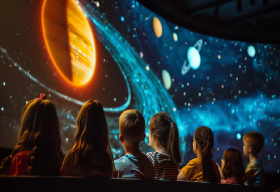
 Mysuru is set to add a major attraction to its tourism landscape with the inauguration of COSMOS-Mysuru Planetarium on November 13, 2026.
The planetarium is located at the Sri Jayachamaraja Wadiyar Centre for Higher Learning, Jayachamarajendra Campus of the University of Mysore, near the foothills of Chamundi Hills in Mysuru, Karnataka.
Developed by the Indian Institute of Astrophysics (IIA) in collaboration with the University of Mysore, the facility is designed to serve as both a public astronomy attraction and an education and training centre for students and teachers. Built by the Indian Institute of Astrophysics (IIA), COSMOS stands for Cosmology Education and Research Training Centre.
The facility is designed to bring astronomy closer to the public through immersive visual experiences, science exhibitions and educational programmes. Its launch is expected to strengthen Mysuru's position as a destination for science and educational tourism.
A New Experience Beyond Traditional Planetariums
The biggest attraction of COSMOS-Mysuru is its advanced LED dome technology. Unlike conventional planetariums that use projectors to display images on a passive dome, this facility uses LED panels that form the display surface itself.
The planetarium features a 15-metre tilted dome comprising approximately 6,150 panels and 4.2 crore individual LEDs. These panels can be controlled in real time, creating detailed and immersive visual presentations of astronomical phenomena.
The system also supports high-resolution 8K visuals, offering visitors a closer and more engaging view of celestial objects and space-related subjects. The tilted design is intended to enhance the audience's viewing experience.
Astronomy Shows and Exhibitions for Visitors
The Sky Theatre will feature professionally produced astronomy programmes and an in-house film exploring the connection between Mysuru's history and astronomy. Shows are planned in Kannada, English and Hindi, making the experience accessible to a wider audience.
Beyond the theatre, the centre will include exhibition halls, a museum featuring astronomy models and artefacts, a lecture hall, a training centre and interactive outdoor exhibits. These facilities are expected to attract school students, families, astronomy enthusiasts and travellers interested in science-based experiences.
The centre is also planned as an astronomy education and training hub for students and teachers, with opportunities for learning, research-related activities and public outreach.
A Boost to Mysuru's Science Tourism
Mysuru is already known for attractions such as Mysore Palace, Chamundi Hills, Brindavan Gardens and its cultural heritage. The addition of COSMOS-Mysuru could introduce another reason for visitors to explore the city, particularly those interested in astronomy and technology.
Speaking about the project, Mysuru-Kodagu Member of Parliament Yaduveer Krishnadatta Chamaraja Wadiyar described the planetarium as "a major addition to the city's educational, scientific and tourism infrastructure."
The project is being developed through collaboration between the Indian Institute of Astrophysics and the University of Mysore. Its activities will also complement the institute's astronomy research and national outreach programmes.
With its advanced LED technology and visitor-focused facilities, COSMOS-Mysuru is expected to create a new science tourism experience in Karnataka and add another attraction to Mysuru's growing visitor circuit.