.png)
Over the last decade, India's professional landscape has transformed at an extraordinary pace. Rapid digitization, global outsourcing, startup expansion, and the mainstreaming of remote work have created opportunities that previous generations could hardly imagine. The tale of professional growth has also had its quiet and personal side, many urban professionals are suffering from widespread professional burnouts.
For many urban professionals in cities such as Bengaluru, Mumbai, Hyderabad and Delhi NCR, they suffer from a severe lack of boundaries around their work. They rarely close their laptops at their appointed times; meetings occur during the evenings; the weekends feel like they are extensions of the weekdays. Work-life flexibility has become blurred due to the pandemic normalising remote work.
This has created a new trend in the enjoyment of travel and lifestyle; work-from-anywhere holidays. These 'holidays' are neither a traditional holiday nor a holiday where an individual is completely removed from their career. Rather, they serve as an alternative to vacations where a profession relocates for a short period of time to a calm destination, all while working remotely. As a result, they are becoming a powerful antidote to professional burnout, providing ways of recovering without requiring individuals to fully unplug from their careers.
The Shift from Vacation to 'Location Reset'
Traditional vacations were once the primary escape valve for stress. However, for many professionals, short holidays often come with their own pressure. There is the anxiety of pending work upon return, the rush to 'unplug quickly', and the feeling that rest must be compressed into a few days. As workloads increased, many people stopped taking long breaks altogether, fearing disruption in career momentum.
work-from-anywhere stays introduce a different philosophy. Instead of separating work and travel, they integrate the two in a more sustainable way. A professional might spend two weeks in Coorg, Manali, Pondicherry, or Gokarna while continuing their daily responsibilities, but in a radically different environment.
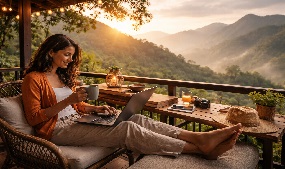
This shift changes the nature of rest itself. Recovery is no longer confined to after-hours or weekends. Instead, it becomes embedded into the rhythm of everyday life. Morning meetings might happen with a view of the hills, and evening deadlines may be followed by walks near the beach. The result is not escapism but recalibration.
Why Urban Work Culture in India is Fueling Burnout
The rapid increase in 'work-from-anywhere' stays indicates a significant shift toward flexibility in today's work environment. The complexity and pace of modern work culture in India have increased due to rising pressure to perform at a high level in fields such as IT services, banking and finance, consulting, and start-ups, which has also resulted in increased cognitive / mental load on professionals across all industries and requiring a greater amount of responsiveness, adaptability, and productivity in multiple time zones.
The lengthy commutes into and out of metropolitan areas are also contributing to this as workers have less personal time for themselves and for their families after a long day of commuting. Commuting relief found by remote workers also comes with an increase in the amount of time they work as there is no longer any physical separation from work to home, since they have converted their homes into work spaces and their workspaces into virtual and 'always on' locations.
As a result, it shows the major cause of burnout, since there is less psychological separation between the office and home environment. Over time, it can lead to fatigue, loss of creativity, and emotional exhaustion and feelings of stagnation. However, 'work-from-anywhere stays' provide a positive solution by re-introducing boundaries between environments while also maintaining professional continuity.
Also Read: Kerala To Boost Middle East Tourism Ties With Indo-Arab Connect 2026
The Psychology of Environment-Driven Recovery
Human psychology is deeply influenced by surroundings. Natural environments, in particular, have been shown to reduce stress levels, improve cognitive function, and enhance emotional regulation. When professionals move from crowded urban settings to quieter landscapes, their nervous systems respond almost immediately.
work-from-anywhere stays leverage this response. The simple act of waking up in a less congested, greener, or more coastal environment can reduce cortisol levels and improve sleep quality. Even when work remains demanding, the backdrop of nature provides a buffering effect.
What makes these stays especially effective is that they do not require complete disengagement from work identity. Unlike traditional retreats or sabbaticals, professionals do not have to 'leave behind' their responsibilities. Instead, they carry them into environments that naturally support mental recovery.
The Rise of Remote Work Infrastructure in India's Travel Hubs
A large part of the new ability to take a work-from-anywhere vacation is due to the rapid building of infrastructure for remote workers in India. Many of the smaller towns and tourist areas now offer coworking spaces as well as high-speed internet access, and accommodations designed specifically with professionals in mind for long-term stays.
Boutique homestays, eco-resorts, and hybrid co-living spaces have started to cater to this developing demographic. The environments of these spaces are built with the intention of providing spaces that allow people to relax and be productive. There are areas to work without distraction, ergonomic furniture to sit in while you work, and there is stable internet available to connect to while working.
Towns and cities such as Himachal Pradesh, Uttarakhand, the coast of Karnataka, and parts of Kerala have become very popular with people who want to work from locations that provide both scenic views as well as functional comfort to help them work effectively over long periods of time. This combination is critical because it maximizes the productivity of employees who want to take the time to recover from their work while still being able to maintain their productivity at the same time.
How Work-from-Anywhere Stays Restore Work-Life Balance
One of the key benefits of these stays is the potential to restore a sense of work/life balance that is often lost in urban environments. In cities, the lines between one's personal and professional lives tend to be blurred due to constant cognitive switching, as one cannot fully disengage their mind from work.
On the other hand, when working remotely from anywhere in the world, natural transitions occur between work sessions. For example, an individual may start their day with a morning work session, followed by a short hike outside, visiting a nearby museum or simply enjoying nature. These natural transitions provide the brain an opportunity to reset between periods of cognitive engagement.
Over time, the repeated nature of these transitions will positively contribute to an individual's productivity as opposed to hindering it. Many professionals who have participated in these types of stays report increased levels of concentration, improved problem-solving skills and greater creativity during and after these experiences because their brains are not constantly stimulated.
Also Read: Indian hotel chains expand resort focus as leisure travel drives growth surge
The Social Dimension of Remote Work Travel
Beyond individual recovery, work-from-anywhere stays also introduce a social dimension that is often missing in conventional remote work setups. Many of these accommodations attract a diverse group of professionals; designers, developers, writers, entrepreneurs, and consultants who live and work in the same space for a limited time.
This creates a unique form of temporary community. Shared meals, informal discussions, and collaborative work sessions often emerge organically. These interactions reduce the isolation that remote work can sometimes create, especially for those living alone in cities.
At the same time, these communities are transient, which prevents the social fatigue that can come from long-term workplace dynamics. People connect meaningfully without long-term obligation, which creates a lighter and more refreshing social experience.
Redefining Productivity through Slower Living
One of the major changes resulting from the rise of work-from-anywhere accommodations is the shift in the definition of productivity. Generally, productivity has been defined in terms of the amount of time I am physically in the office or how quickly I respond to emails and calls. With these types of accommodations, productivity can also be measured in terms of quality of work rather than just the number of hours worked.
When people are removed from the constant rush of urban life, they often find that living a slower lifestyle does not decrease their efficiency. On the contrary, a slower lifestyle leads to greater clarity in completing all of my tasks with fewer distractions; making better decisions; and significantly reducing my mental fatigue.
These observations call into question the long-held belief that high-performing employees must work under pressure all of the time to perform at their highest levels. Rather, they suggest that to perform at your best consistently, your mental health must be maintained; the quality of your work environment must be maintained; and your emotional state must be relatively stable.
Challenges and Limitations of the Lifestyle
Although there are many advantages to a work-from-anywhere policy, there are also some restrictions. Not all jobs are suitable for this type of arrangement, especially those that require a physical presence or have rigid scheduling. In addition to these types of jobs, there are also other factors that can limit flexibility when working remotely such as your work hours on weekends or during other time zones, due to having meetings scheduled throughout your entire workday.
As well as the above-mentioned restrictions to remote working, potential drawbacks include the chance of glamourizing the entire experience. Without taking care of your needs and keeping up with the demands of working from any location can wear on you very quickly, and make it more difficult to establish and maintain a healthy balance between leisure and work.
Furthermore, there are still many areas where there are no internet connections, inadequate healthcare services/insurance and a lack of long-term costs associated with residing in said areas, therefore despite the popularity of this trend, it is not available to everyone at this time.
The Future of Work-from-Anywhere Culture in India
Despite these challenges, the trajectory of work-from-anywhere stays in India appears strong. As companies continue to adopt hybrid and remote-first policies, professionals are increasingly seeking environments that support both performance and well-being.
In the coming years, this trend is likely to evolve into a more structured ecosystem. Companies may begin offering 'workstation allowances', curated retreats, or partnerships with hospitality providers. Travel platforms are already adapting by creating long-stay remote work packages tailored for professionals.
More importantly, this trend reflects a deeper cultural shift. Work is no longer seen as something that must be confined to a desk in a city. Instead, it is becoming something more fluid; capable of existing alongside movement, nature, and personal well-being.
A New Definition of Recovery in a Connected World
work-from-anywhere stays are not just a travel trend; they represent a response to a modern crisis of exhaustion. For India's burnt-out professionals, they offer something rare and valuable: the ability to heal without stepping away from ambition.
In blending work with restorative environments, they challenge the idea that productivity and peace are opposing forces. Instead, they suggest that both can coexist when the conditions are right.
As this movement grows, it may fundamentally reshape how professionals think about success; not as constant acceleration, but as the ability to sustain performance while staying mentally and emotionally balanced.